Labor Law
Dismissals, terminations, protection of rights and Karin Law, with advice from the first request.
See area → Lex Juicios Lawyers
Lex Juicios Lawyers · People
Family Law regulates legal relationships derived from marriage, parentage, alimony, personal care and protection of children and adolescents, in accordance with the Civil Code, Law No. 19,968 that creates the Family Courts and current complementary legislation.
Our law firm provides strategic advice on divorce, alimony, custody, visitation, financial compensation and domestic violence, with a technical, rigorous approach focused on the protection of rights.
The maintenance obligation is regulated in the Civil Code and special laws.
Includes:
The amount is determined considering the needs of the obligor and the economic capacity of the obligor.
The personal care of the children corresponds jointly to both parents, or it can be determined exclusively or shared by agreement or judicial resolution, always ensuring the best interests of the child.
It is the right and duty of the parent who does not have personal care to maintain regular, healthy and fluid contact with their child. Its establishment seeks to guarantee the comprehensive development of the minor and their right to co-parenting.
It occurs when one of the spouses, as a result of having dedicated themselves to caring for the children or doing household chores, was unable to carry out a paid or lucrative activity during the marriage, or did so to a lesser extent than they could and wanted.
Request a personalized, confidential legal evaluation and protect your rights with strategic professional advice.
The law contemplates urgent measures:
The procedure is urgent and quick to process.
In addition to the Civil Code, the Chilean family system is complemented by special laws:
Creates Family Courts and regulates judicial procedure.
Regulates marriage, separation and divorce.
Establishes the National Registry of Food Pension Debtors.
It is the regulatory core of Chilean Family Law. Here they are regulated:
Concept, requirements and legal effects (art. 102 et seq.).
Regulation of the legal bond between parents and children, recognition and challenge (art. 179 et seq.).
Rights and duties of parents regarding the child's property (art. 243 et seq.).
Food Law
Legal obligation to provide food (art. 321 et seq.).
Protection of incapable people (art. 338 et seq.).
Family legal situation of the person (arts. 304 et seq.).
This book contains the structural bases of the Chilean family legal system.
Key Details of Article 304
Relevant points related to civil status in Chile:
This article is located in Title IX of Book I of the Civil Code, dedicated to civil rights and obligations.
Lex Juicios Lawyers News from Family Lawyers in Santiago by Author: EL Mostrador.
The Judiciary is preparing the First National Children's Day, a meeting that will bring together ministers, judges, representatives of Family Courts from all over Chile and children and adolescents from the Advisory Council of the Specialized Protection Service on November 28 and 29. The instance, which will take place in the Administrative Corporation of the Judiciary and in the Court Palace, seeks to present advances, challenges and new proposals to strengthen child protection towards 2030.
During the last year, various commissions made up of ministers, judges and technical teams have worked on initiatives that address key issues such as the application of Law 21,430, that changed the paradigm from a tutelary vision to that of “subjects of law”, coordination between institutions, alternative care modalities and judicial monitoring mechanisms. These commissions have had the support of professionals from Technical Advisories, the Protection Measures Monitoring Center, the Children's Ombudsman's Office, Unicef and government and civil society organizations.
The meeting seeks to bring together authorities and teams from Family Courts to present proposals, analyze challenges and advance a common work agenda towards 2030 in matters of childhood and family.
The commissions that have worked on the preparation of this day were organized by thematic areas, among them:
These working groups will deliver a notebook compiled with proposals and analyzes on childhood and family, prepared from the work developed by each commission. The document will define new challenges and directions, with a focus on strengthening innovation, inter-institutional coordination and collaborative work to advance the protection of children and adolescents.
The event will also feature the participation of members of the Advisory Council of the Specialized Protection Service, and will present the special program “Voices of the Future”, the first podcast of the Judiciary dedicated to justice and the rights of children and adolescents. “Author: EL MOSTRATOR”
When there is conflict between parents, you can:
We act quickly to protect the child's well-being.
In Chile there are:
A family lawyer from Lex Juicios Lawyers speeds up the process and avoids errors that delay the sentence. We usually manage to obtain it in approximately 30 days. a divorce decree.
More than 200 people have trusted Lex Juicios Lawyers
More than 200 clients served. 4.5 rating on Google. Real verified opinions.
We offer expert representation to process your marriage term in the most expeditious manner and safeguarding your property and family rights:
The determination and collection of alimony requires a detailed technical analysis to ensure the well-being of the children and the proportionality of the burdens:
If you are not receiving the pension or need to adjust the amount due to a change in financial circumstances, an attorney can:
Diligent processing thinking about the well-being of your children.
A Family Lawyer in Chile not only processes trials, but also designs a procedural strategy that protects property and family rights. In matters such as divorce, alimony or personal care, a poor defense can generate permanent economic and legal consequences.
Professional advice allows:
The Chilean system is based on:
These principles guide the decisions of the Family Court.
Family Law is the branch of civil law that regulates legal relationships derived from marriage, filiation, adoption, alimony, personal care of children and the protection of children and adolescents.
In Chile, Family Law is regulated mainly in the Civil Code, Law No. 19,968 that creates the Family Courts, the Civil Marriage Law and other special regulations.
Its purpose is to protect the family structure and guarantee respect for fundamental rights, especially the best interests of the child.
A Family Lawyer in Chile advises and represents people in family conflicts, designing legal strategies to protect property and personal rights before the Family Court.
Family Law is the branch of civil law that regulates marriage, divorce, parentage, alimony, personal care and relationships between parents and children. In Chile it is regulated by the Civil Code and the Family Court Law.
It regulates from article 1 to article 2525, covering the entirety of private law: persons, assets, inheritances and obligations.
It contains fundamental rules on:
Establishes the general principles of application of the law.
It is the basis of Family Law.
Regulates:
Here the family organization and the marital status of people are legally structured.
Regulates:
It is the axis of real law.
Regulates:
It is the foundation of inheritance law.
It is the longest book of the Civil Code.
Regulates:
This book structures the patrimonial and commercial dynamics of private law.
Article 2525 of the Civil Code of Chile establishes that the extinctive (or liberatory) prescription of ordinary actions occurs after the passage of five years. This rule applies to the extinction of rights and actions, generally when an action that requires a specific statute of limitations has not been exercised.
Key details about Article 2525:
The structure of the Civil Code divides private law into four large areas:
In matters of Family Law, Book I is the regulatory core, while Book IV affects the property effects of marriage and divorce.
FAMILY LAWYERS IN SANTIAGO
LEX TRIAL FAMILY LAWYERS
It depends on the type of divorce and the burden of the court. An uncontested divorce can take anywhere from 30 days to 2 to 6 months. Unilateral or fault divorce can be extended longer if there are disputes over alimony, property or personal care.
Marriage certificate, accreditation of the cessation of cohabitation and regulation of matters such as food, personal care and property. The procedure is processed before the competent Family Court.
Three years for unilateral divorce and one year for divorce by mutual agreement, counted from the effective cessation of legally accredited cohabitation.
Yes. Unilateral divorce is appropriate when there is cessation of cohabitation for the legal period, even if the other spouse does not agree.
It is compensation that can be requested by the spouse who suffered economic loss for dedicating themselves to the home or children during the marriage.
The needs of the obligor and the economic capacity of the obligor are considered. There is no fixed percentage, but the courts apply proportionality criteria.
The court can order withholding of wages, suspension of driver's license, arraigo and registration in the National Registry of Debtors.
Yes, when the financial circumstances of the obligor change or the needs of the beneficiary increase.
Applicable if the obligor's income decreases or economic conditions substantially change.
Accrued pensions expire according to general rules, but can be interrupted by judicial action.
It is a system that registers those who maintain food debts, generating restrictions such as financial and administrative impediments.
Yes. The Treasury can withhold returns to pay food debts.
It must be requested before the Family Court, proving that the measure favors the best interests of the child.
It is a modality where both parents exercise personal care in a joint and coordinated manner.
Through a request for modification if circumstances change or there is repeated non-compliance.
The court can apply fines or modify the regime.
It can be done voluntarily before the Civil Registry or by court ruling.
Yes, through judicial action within the established legal deadlines.
When there is a dispute over parentage, the court may order biological testing.
He has the same rights and duties with respect to the legally recognized child.
Those acquired during the marriage, except for legal exceptions as personal property.
Inventory and division of assets is carried out, judicially or notarized, depending on the case.
It is a property regime where each spouse manages their own assets.
Regime where each spouse manages their assets, but profits are compensated at the end.
You can report it to Carabineros, PDI or directly to the Family Court.
Restraining order, prohibition of approach and urgent precautionary measures.
Yes, in serious cases that affect the interest of the minor.
Set of rights and duties of parents regarding property of the minor child.
Judicial authorization may be requested or departure prevented if it affects the rights of the minor.
Yes, by court order when there is a risk for the child.
Through specialized judicial procedure and evaluation of the competent Service.
Prior process to try to agree on matters such as food or visits.
In most family matters, yes, before starting a trial.
It depends on the complexity of the case and professional fees.
Yes, from the date the claim was filed.
The court can investigate and set pension according to actual capacity.
Proceeds through judicial means in well-founded cases.
Temporary measure while the main trial is resolved.
Form of violence that involves control or deprivation of economic resources.
When there is legal controversy in matters regulated by the Family Court Law
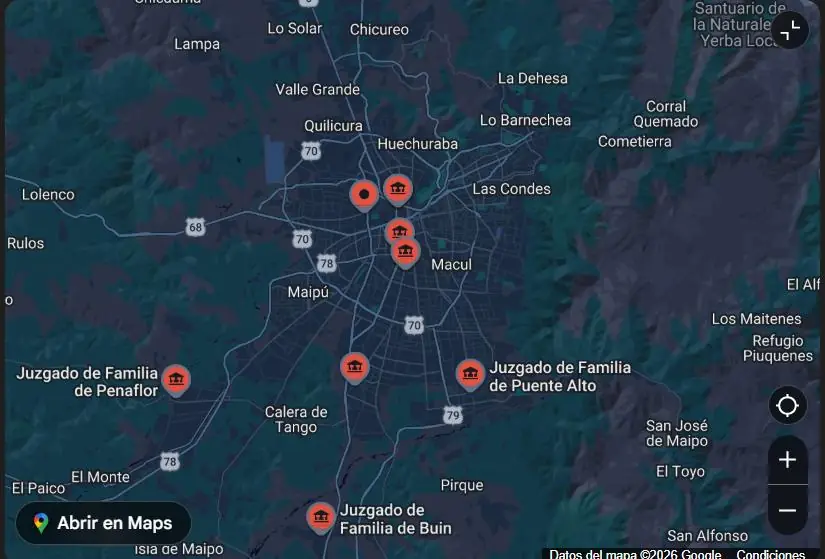
Metropolitan Region - Family Building
1st Family Court · CALL · 2nd Family Court · CALL · 3rd Family Court · CALL · Precautionary Measures Center · URGENT
A lawyer from Lex Juicios Lawyers can take your case and represent you in court today.
REQUEST REPRESENTATION NOW
Court Hours: Monday to Friday 08:00 - 14:00 hrs.
LEX TRIAL LAWYERS
If the other parent prevents visits or does not comply with schedules:
This avoids constant conflicts and provides legal stability.
In urgent cases you can:
Time is crucial here. Immediate advice can make a difference. Violence can come from a woman to a man or from a man to a woman. In any of these cases, it is very important to report and take the service of a lawyer Lex Juicios Lawyers
In the Chilean legal system, as established in the Law No. 19,968 that creates the Family Courts, the vast majority of cases cannot be presented directly before a family judge. The law requires a prior and mandatory process of Family Mediation before starting a trial.
If your legal problem is related to any of the following matters, you must undergo mediation before suing:
If both parties reach an agreement during mediation, a Minutes of Agreement. This document is sent to the corresponding Family Court for approval. Once approved by the judge, you have the same value as a final court ruling.
If one of the parties does not attend the summons or if, by attending, it is not possible to reach an agreement, the mediator will declare the process frustrated and will issue the Frustrated Mediation Record. This document is an enabling and mandatory legal requirement so that our family lawyers can draft and file your claim in court.
Contact us and leave your problem in good hands, our fees are flexible.
In Lex Juicios Lawyers We understand that family contingencies require immediate action, no matter where you are. Therefore, we provide comprehensive coverage that combines in-person attention in our Santiago offices with solid digital representation and remote litigation for the entire national territory.
We actively represent and litigate before all the Family Courts of Santiago, covering all the communes of the Metropolitan Region, with special emphasis on:
Thanks to the electronic processing of the Family Courts in Chile, our team sponsors cases and appears remotely and in person in the main jurisdictions of the country:
We handle mutually agreed and unilateral divorces, alimony and their increases, personal care, direct and regular relationships, domestic violence and mandatory mediation.
Describe your case by WhatsApp or email and a family law lawyer will contact you to guide you at each stage, with confidential attention.
Lex Juicios Lawyers It has a multidisciplinary team in family matters. All queries are treated under absolute confidentiality.
Write to us indicating your name and the subject you need to review, and we will coordinate an initial conversation.
Write us your family law matter and we will respond within business hours.
Family law regulates the personal and property ties between parents, children, spouses and cohabitants. In Chile, this matter is addressed by the Family Courts, where specialized legal advice is required to protect your rights and those of your family.
We advise you throughout the entire process, from the preparation of the lawsuit to the ruling, including financial compensation and liquidation of common assets.
If the other parent does not comply with their obligations, we file claims for support, adjustments and payment compliance before the courts.
We represent your rights as a father or mother in matters of personal care and in establishing the communication regime.
We protect the emotional rights of children, even in relationships with other relevant family members.
Dismissals, terminations, protection of rights and Karin Law, with advice from the first request.
See area →Economic crimes, scams, money laundering, illicit association and highly complex criminal defense.
See area →Asset seizures, damages, precarious property, leases, partition trials, civil lawsuits and high-value inheritances.
See area →Traffic fines, TAG, accidents and co-ownership, with personalized monitoring of each cause.
See area →Temporary residence, visas, appeals and permanent stay.
See area →Sustained track record in highly complex litigation, corporate criminal defense and cross-border advice, with dedication and technical rigor in each assignment.
We integrate specialists from various legal areas to address your challenges from a civil, tax, labor and criminal perspective in a single coordinated strategy.
Direct contact with the professional responsible for your matter. Your case is treated under strict confidentiality, prioritizing the peace of mind of your business.
Let us analyze your case under absolute reserve and confidentiality.